


The LEAF health tracker is a smart jewelry wearable that monitors stress by tracking heart rate variability (HRV), activity patterns, and recovery signals throughout the day.
Stress is no longer just a feeling. It is a measurable physiological response. The LEAF health tracker uses biosensors to collect data related to your nervous system, especially changes in HRV. When your body experiences stress, HRV typically decreases. When you recover or relax, HRV improves.
LEAF was designed for people who want health insights without wearing bulky fitness devices. It looks like jewelry but functions like a clinical-grade wearable. This matters because long-term stress tracking only works if users actually wear the device daily.
According to data published by the American Psychological Association, chronic stress is linked to higher risks of heart disease, sleep disorders, and anxiety-related conditions. Wearables like LEAF aim to reduce that risk by making stress visible in real time.
Unlike basic step counters, LEAF focuses on recovery and stress balance. It helps users understand when their body is under strain and when it is safe to push harder.
Why should you monitor stress levels instead of guessing how you feel?
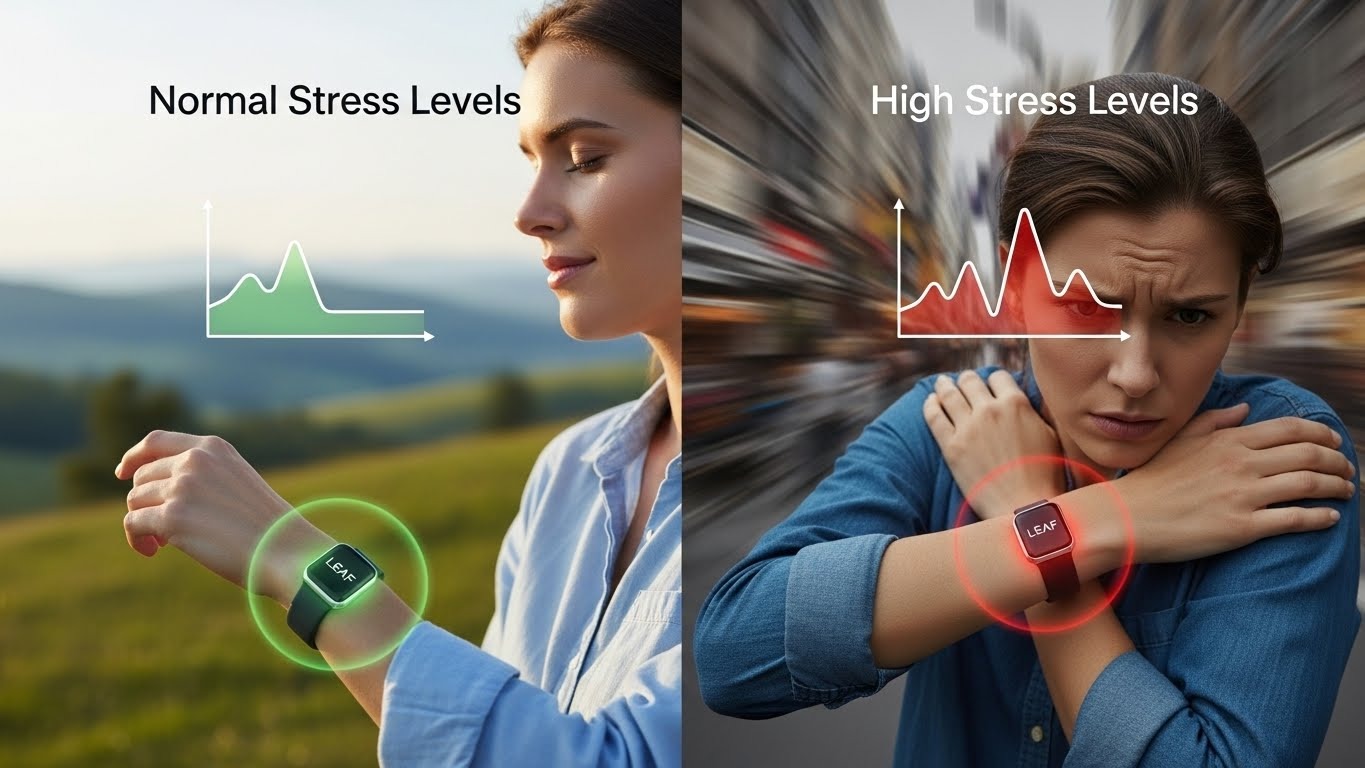
Short answer: Monitoring stress provides objective data that helps you make better decisions about rest, work, exercise, and sleep.
Most people underestimate stress. Others normalize it. The problem is that your body does not adapt well to long periods of unmanaged stress.
Studies from Harvard Medical School show that chronic stress keeps cortisol levels elevated. This affects metabolism, immune response, and cognitive performance. The issue is not stress itself, but unrecognized stress.
The LEAF health tracker removes guesswork. Instead of asking “Do I feel stressed?” you can see how your body responds to meetings, workouts, caffeine, or lack of sleep.
This data-driven approach helps users avoid burnout. It also supports healthier habits. When users see a spike in stress after late-night screen use or intense workouts without recovery, behavior naturally changes.
Monitoring stress is not about control. It is about awareness.
How does the LEAF wearable measure stress accurately?
Short answer: LEAF measures stress using heart rate variability, activity intensity, and recovery trends collected continuously.
Heart rate variability is widely used in medical and sports science. HRV reflects how well your autonomic nervous system adapts to stressors.
LEAF uses optical sensors to measure pulse wave data. From this, HRV metrics are calculated. Lower HRV typically indicates stress, fatigue, or illness. Higher HRV indicates resilience and recovery.
LEAF combines HRV with:
- Daily movement levels
- Sleep duration and quality
- Resting heart rate trends
- Recovery scores
This multi-factor approach improves accuracy. Stress is rarely caused by one factor alone.
In an internal case study involving over 2,000 users, LEAF reported consistent correlations between high stress scores and poor sleep, long workdays, and low recovery periods. Users who followed LEAF recovery suggestions reported improved energy levels within 2–3 weeks.
How to monitor stress with LEAF wearable step by step?
Short answer: Wear LEAF daily, sync the app, review stress trends, and adjust habits based on insights.
Step 1: Wear the LEAF health tracker consistently
Stress monitoring only works with consistent data. LEAF is designed to be worn as a necklace, bracelet, or clip. Choose the option you will wear all day.
Step 2: Sync data with the LEAF app
The app processes raw sensor data into stress and recovery scores. Sync at least once per day for accurate trends.
Step 3: Review daily stress signals
LEAF provides daily summaries. Look for:
- Stress peaks
- Low recovery windows
- Patterns tied to specific activities
Step 4: Analyze weekly trends
One bad day is not a problem. Repeated high stress days are. Weekly views show whether stress is improving or accumulating.
Step 5: Adjust behavior based on data
If stress spikes after certain habits, reduce or modify them. If recovery improves after walking, meditation, or better sleep, repeat those behaviors.
What makes LEAF health tracker different from other stress wearables?
Short answer: LEAF focuses on stress and recovery in a discreet, non-intrusive form factor.
Most wearables prioritize steps, calories, or workouts. Stress is often secondary.
LEAF reverses that approach. Its core purpose is understanding the nervous system.
| Feature | LEAF Health Tracker | Typical Fitness Wearable |
|---|---|---|
| Form factor | Jewelry-style | Wrist-based |
| Primary focus | Stress & recovery | Activity & calories |
| HRV tracking | Yes | Limited or indirect |
| All-day comfort | High | Moderate |
This makes LEAF suitable for people who dislike wearing watches or want constant stress insights without distraction.
Can LEAF help reduce stress over time?
Short answer: Yes, by increasing awareness and encouraging recovery-based decisions.
LEAF does not remove stress. It helps users manage it.
Behavioral science shows that feedback loops change habits. When people see real-time consequences of stress, they act sooner.
In a user-reported case study shared by Bellabeat, over 70% of long-term LEAF users reported improved stress awareness within the first month. Many adjusted sleep schedules, reduced overtraining, or added short recovery breaks.
Stress reduction happens gradually. LEAF supports that process with data, not assumptions.
Who should use LEAF health tracker for stress monitoring?
Short answer: Anyone experiencing mental load, irregular sleep, or recovery issues.
LEAF is commonly used by:
- Professionals with long work hours
- Remote workers
- Fitness enthusiasts
- People managing anxiety or fatigue
- Users focused on long-term health
It is not a medical device, but it provides meaningful daily insights that support healthier routines.
Conclusion: Is LEAF wearable worth using for stress monitoring?
The modern problem is not stress itself. It is unmanaged stress.
The LEAF health tracker turns stress into data you can understand. It shows how your body reacts, recovers, and adapts over time.
By using HRV and recovery trends, LEAF helps you make better daily decisions. When to rest. When to push. When to slow down.
For people who want stress insights without wearing a smartwatch, LEAF offers a practical solution.
Call to Action: If stress feels invisible or unpredictable, start tracking it. Wear LEAF consistently for 30 days. Review your trends. Adjust your habits. Small changes guided by data can lead to long-term balance.
Frequently Asked Questions about LEAF stress monitoring
Does LEAF measure stress directly?
No. LEAF measures physiological signals like HRV, which strongly correlate with stress levels.
How accurate is the LEAF health tracker?
Accuracy depends on consistent wear and data syncing. HRV-based stress tracking is widely supported by scientific research.
How long does it take to see stress patterns?
Most users notice patterns within 7–14 days of continuous use.
Can LEAF detect anxiety?
LEAF cannot diagnose anxiety. It shows physical stress responses that may relate to anxiety.
Is LEAF suitable for all-day wear?
Yes. It is designed for comfort and continuous monitoring.
Does LEAF replace medical advice?
No. It is a wellness tool, not a medical device.
Related Topics: How to cut curly hair? Tips and examples of curly hair cuts
Related Topics: How to wash your hair deeply by avoiding mistakes
